

Breaking News! CPSC New Regulation Meets a Relaxation Policy on Its First Implementation Day!!!
Breaking News! CPSC New Regulation Meets a Relaxation Policy on Its First Implementation Day!!!
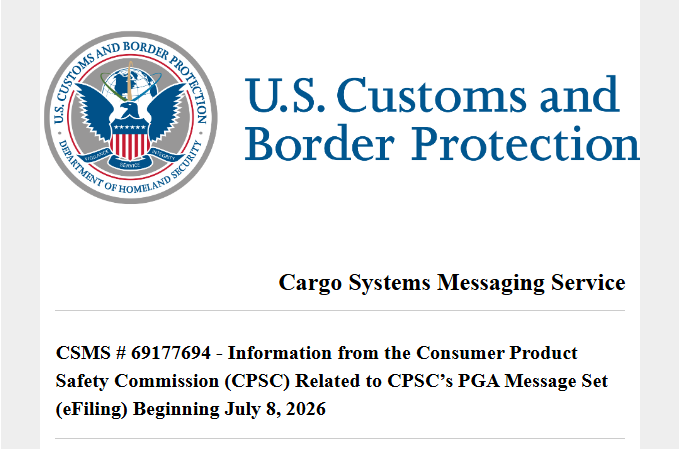
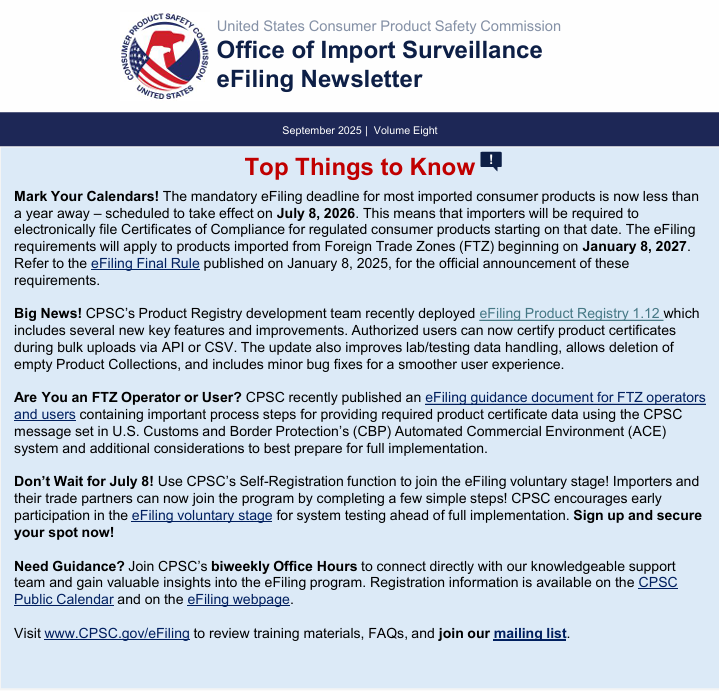
On July 8, 2026, the US Consumer Product Safety Commission (CPSC) electronic filing system officially became mandatory. The entire industry had widely worried about the harsh situation of "cargo detained if filing is missing." On the very day the new regulation landed, the US Customs and Border Protection (CBP) issued an official notice via CSMS #69177694, clarifying that CPSC will adopt a differentiated and relaxed enforcement approach. Combined with the system's performance on the first day, many cross-border enterprises and customs brokers were temporarily relieved of a heavy burden. But does the smooth first day mean it is time to rest easy? Today, Jinlian International will break down the real situation for you based on frontline customs clearance feedback.
I. First-Day Clearance Reality: System Non-Mandatory, Release Normal, but Hidden Concerns in the "Relaxation"
Our company tracked US-route customs clearance dynamics throughout July 8 and summarizes the core feedback as follows:
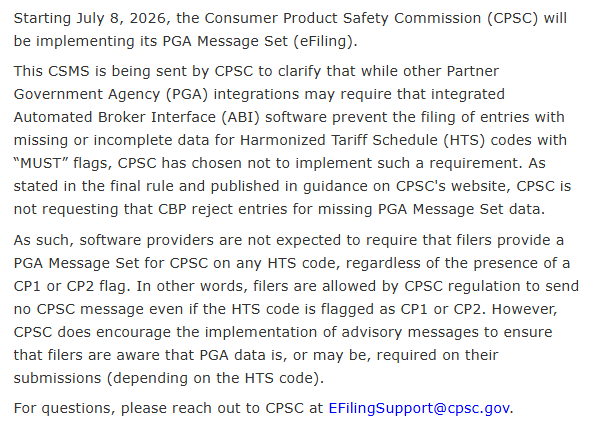
1. The system was confirmed to be in "non-mandatory" mode: even without entering the three corresponding IDs required by CPSC (such as factory ID, product ID, production date code, etc.), customs declarations were still submitted normally, and clearance status was no different from before. The system did have a brief outage of about one hour during the day, presumably technical debugging just after the policy landed, further confirming the current "friendly period" at the system level.
2. CPSC clearly does not reject declarations for missing data: customs brokers are not required to forcibly send PGA message sets, and entries with HTS codes carrying the CP mark do not trigger automatic interception even with missing information.
3. Children's products remain a "high-voltage line": despite the overall relaxation, children's products (toys, children's clothing, baby products, etc.) still fall under CPSC's key strict supervision scope. Our company currently maintains a prudent order-acceptance strategy for such goods and recommends clients separately confirm compliance documents.
4. IOR and registered importer inconsistency: many clients asked whether clearance is possible when the "registered importer" on the CPSC certificate differs from the actual clearance IOR (Importer of Record). First-day practice shows: as long as the eFiling electronic filing is successfully submitted, normal filing and release are possible. However, note that this only solves the clearance release stage; if a later inspection occurs and product testing fails to meet standards, customs still has the right to detain the cargo.
II. What Exactly Does CSMS #69177694 Relax?
Based on the CBP official notice, the core of this relaxed enforcement is the cancellation of front-end admission interception, not a lowering of back-end compliance standards.
III. Reminders Behind the First-Day "Relaxation": Release Does Not Equal Exemption; Post-Hoc Review Is the Real Test
Our company especially reminds all sellers:
IV. Practical Advice for Cross-Border Sellers: Compliance Is the Only Amulet
Based on first-day feedback and CPSC official rules, we provide the following action guide:
V. Relaxation Is an Attitude, Compliance Is the Foundation
On the first day of the CPSC new regulation, the feared "clearance paralysis" did not occur. CBP and CPSC demonstrated regulatory flexibility with a phased relaxation. But Jinlian International emphasizes again: relaxation does not equal exemption, and release does not equal safety. All consumer products exported to the US market, especially children's products, must establish complete compliance files.
We suggest sellers use this window period to quickly improve foundational work such as product testing, certificate filing and supply chain traceability. Jinlian International will continue to follow the latest developments of CPSC and CBP to safeguard your customs clearance compliance.